

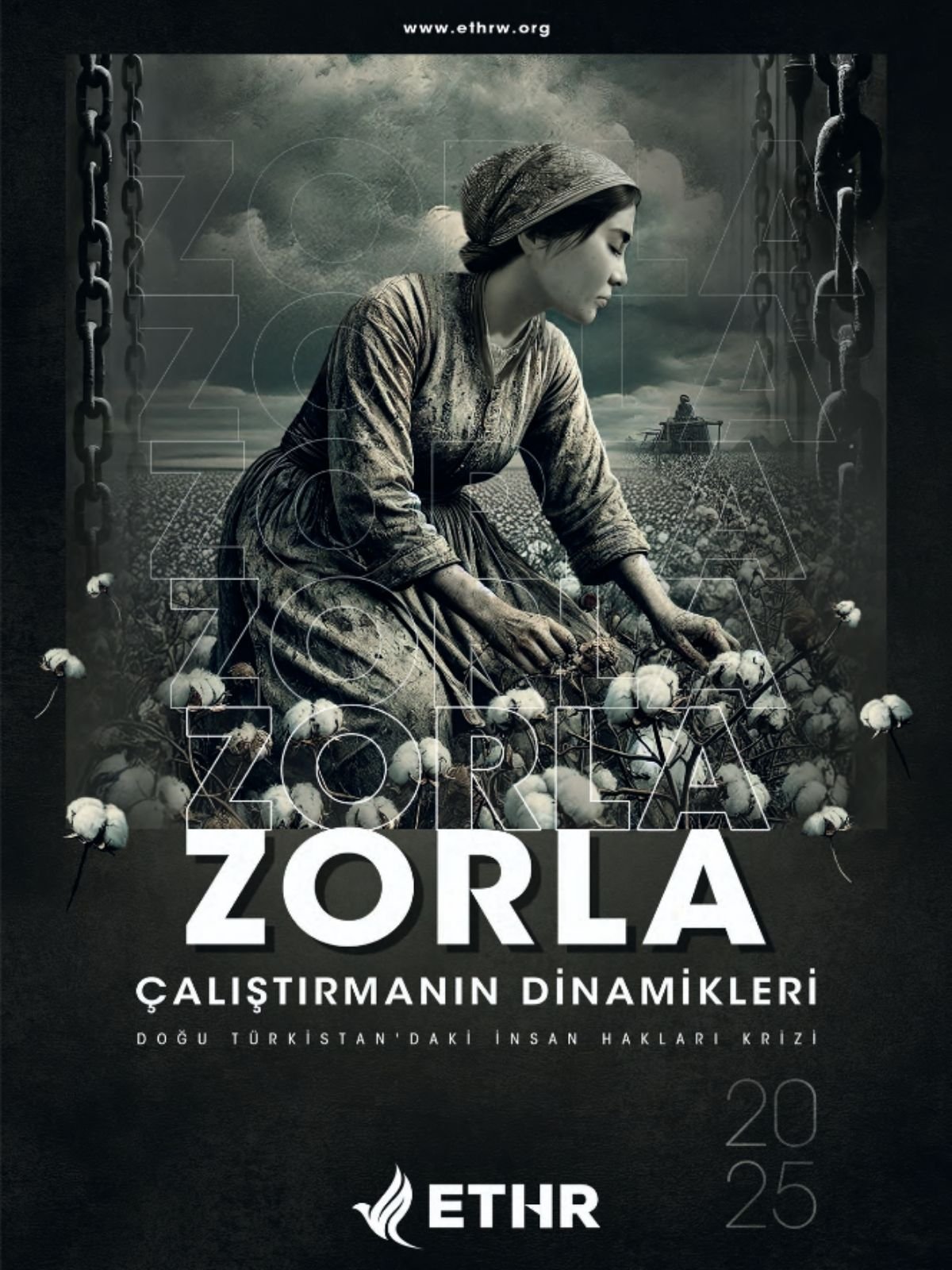
Prepared by the East Turkistan Human Rights Watch Association, “The Dynamics of Forced Labour” provides a comprehensive examination of forced labour, defined as the exploitation of human labour without genuine consent through threats, pressure, or coercion. Published on 22 February 2025, the report demonstrates that forced labour is not merely a violation of labour rights, but a modern form of slavery that directly undermines individual freedom, human dignity, social justice, and economic equality.
The first section of the report examines the historical and conceptual development of forced labour. It traces the phenomenon from slavery systems in antiquity and serfdom in the Middle Ages to labour exploitation during the Industrial Revolution and contemporary practices such as human trafficking, debt bondage, and child labour. In doing so, the report shows that although forced labour has changed form over time, it has continued to exist through the control and exploitation of human labour.
The second section evaluates the national and international legal frameworks established to combat forced labour. It examines the responsibilities of states through the conventions of the International Labour Organization, United Nations instruments, the European Convention on Human Rights, and other regional human rights mechanisms. The report also considers Türkiye’s legal regulations and practices, assessing their relationship with international human rights standards.
At the centre of the study is the forced labour system implemented by China in East Turkistan. The report examines compulsory labour transfers, labour exploitation linked to internment camps, and state-run programmes presented under the labels of “vocational training” or “poverty alleviation.” It states that these policies particularly target Uyghurs and other Turkic and Muslim communities in the region. Individuals are reportedly transferred to agricultural sites, factories, and workplaces in other regions, while those who refuse may face threats of renewed detention or punishment.
According to the report, forced labour mechanisms in East Turkistan are not confined to the region and should not be regarded solely as a local human rights issue. Production processes associated with forced labour extend into global supply chains across numerous sectors, including cotton and textiles, electronics, solar panel manufacturing, and mining. Consequently, companies and consumers in different parts of the world may encounter products directly or indirectly connected to this system. The report stresses that companies must increase supply-chain transparency and terminate relationships with production processes linked to human rights violations.
The report’s concluding section also presents concrete recommendations for Türkiye. These include examining the production processes of imported goods from China, particularly high-risk products in the textile, agricultural, electronics, and related sectors; adopting customs measures against goods produced through forced labour; and establishing monitoring and certification systems consistent with international standards. It further states that stronger information-sharing and cooperation between Türkiye, the ILO, the United Nations, and other international organisations would make an important contribution to the global fight against forced labour.
“The Dynamics of Forced Labour” demonstrates that China’s forced labour policies in East Turkistan cannot be regarded as ordinary economic development or employment programmes. Rather, the report presents these practices as part of a systematic mechanism of repression connected to assimilation, social control, and economic exploitation. It calls on governments, international organisations, companies, and individuals to assume responsibility and take decisive action to prevent products made with forced labour from entering global markets.